Church of Our Lady of Immaculate Conception, Goa

Church of Our Lady of Immaculate Conception, Goa

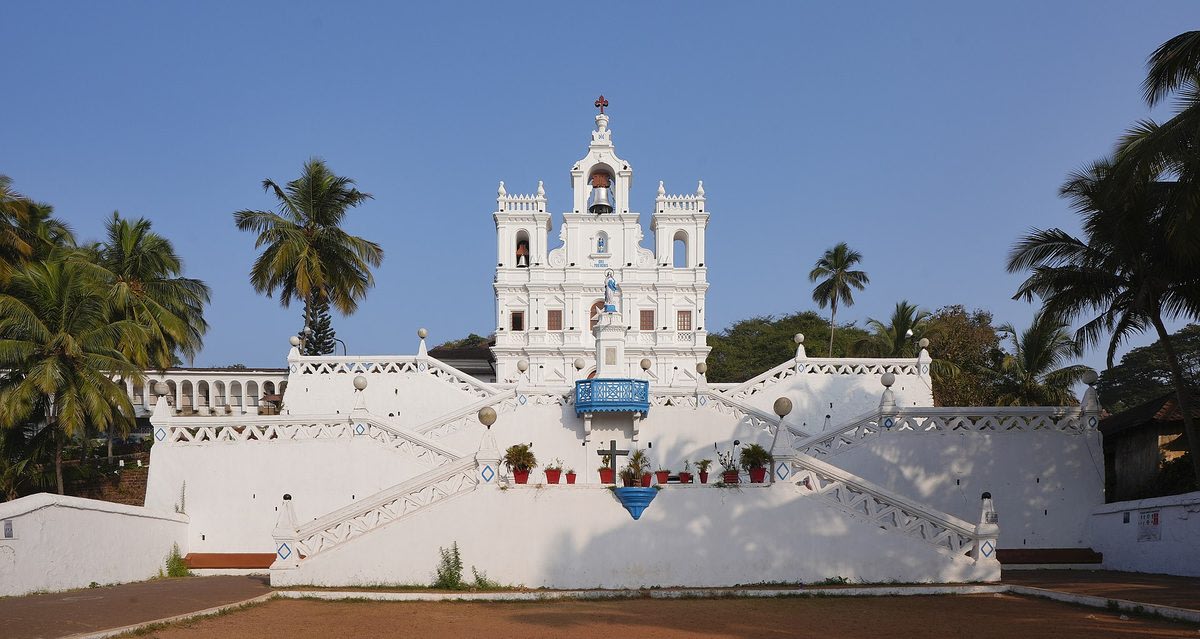
The Church of Our Lady of the Immaculate Conception also called Panjim Church, has weekly Portuguese Mass

Type
Church
Country
India
Location
Rua Emídio Garcia, Altinho, Panaji
Scroll
01At a Glance

Standing tall right in the very heart of Panjim, the capital of Goa, is the Church of Our Lady of the Immaculate Conception, more popularly called the Panjim Church. First built as a chapel in 1541 on the slopes of the Conceicao Hill, which overlooks the city, it was frequented by sailors between from Lisbon. In those days, Panjim was the first port of call for sailors bound for the then capital city of Ela- present day Old Goa. The chapel had to be rebuilt as it soon proved inadequate to accommodate the growing numbers. It was replaced by a larger church which was consecrated in 1619, and which is the church that exists today. While Goa’s most beautiful churches of the Portuguese era are concentrated in Old Goa, a mere sprinkling of equal stature can be found outside the former capital. The Panjim Church can be easily ranked among the latter, thanks to its distinctive appearance. Known in Portuguese as the Nossa Senhora da Immaculada Conceicao or Our Lady of the Immaculate Conception, this is Panjim’s most iconic church. The trademark criss-crossing staircases in front of the church were added in the 18th century and give the church its single most remembered feature. The church is built with a remarkable amalgam of Portuguese-Baroque elements which have been modified to suit the climatic conditions of Goa. The layout of the church is traditional cruciform with a nave and transepts. A bas-relief carving of the Last Supper adorns the mail altar, while the pulpit has a depiction of the Holy Spirit in the form of a dove. It is the opulently carved and gilded reredos of breathtaking beauty, where the statue of Goa’s patron saint St Francis Xavier, is prominently displayed. Its other claim to fame is the huge bell that adorns the belfry, which was moved here from the ruins of the Augustinian Church at Monte Santo in 1871. The bell was initially moved to the chapel at Fort Aguada, but a decision was later taken to install it in the more prominent Church of Our Lady of the Immaculate Conception, Panjim. The bell is second only to the Golden Bell of the Se Cathedral in Old Goa and weighs an astounding 2250 kgs. The belfry had to be reinforced before the structure could handle the added load. Living up to its name, the Panjim Church is immaculately finished in dazzling white, which in the brightness of the sun gives it a divine appearance. In an effort to preserve its colonial heritage, a mass in Portuguese is celebrated at the church every Sunday at 10.30 am. The feast of the Immaculate Conception is celebrated on the 8th of December and this is when the parish springs to life. A nine day Novena to Our Lady precedes the celebrations, where following the procession and a firework display, a band plays lively mandos and fados- the traditional Goan music forms.

1

Standing tall right in the very heart of Panjim, the capital of Goa, is the Church of Our Lady of the Immaculate Conception, more popularly called the Panjim Church

2

First built as a chapel in 1541 on the slopes of the Conceicao Hill, which overlooks the city, it was frequented by sailors between from Lisbon

3

In those days, Panjim was the first port of call for sailors bound for the then capital city of Ela- present day Old Goa

4

The chapel had to be rebuilt as it soon proved inadequate to accommodate the growing numbers

5

It was replaced by a larger church which was consecrated in 1619, and which is the church that exists today

02Plan Your Visit
Getting There
Church Square, Panaji (Panjim), Goa 403001

At Church Square in the centre of Panaji, the capital of Goa. From Panaji bus terminal: 10-minute walk. From Goa airport (Dabolim): 25 km, 30 minutes by taxi. From Margao railway station: 30 km, 40 minutes. From Old Goa: 10 km, 15 minutes.

Open in Google Maps →
IST (UTC+5:30)
--:--:--

Best visited in the morning, when the white facade catches the sun and the city is quieter. Evening Masses are also excellent. The Fontainhas Latin Quarter and the Mandovi riverfront are both within a 10-minute walk and complete a Panaji morning.

Opening Hours
Church7:00 AM - 12:30 PM, 3:00 PM - 7:30 PM daily
03Must See

What to seek out, and why it matters

I
Church Square

The White Baroque Facade

The facade of the Church of the Immaculate Conception — blinding white in the Goan sun, with its baroque curved gable, bell towers, and the extraordinary double staircase sweeping up to the entrance — is one of the great architectural sights in India. No photograph fully captures the relationship between the church and the surrounding square; it must be seen in person.

II
Exterior approach

The Double Staircase

The twin staircases that sweep up symmetrically to the main portal — a design feature unique in Goa and unusual in Indian church architecture — make the approach to the church itself a form of ascent. Walking up the stairs toward the white facade and the blue Goan sky above is a genuinely uplifting physical experience.

III
Inside the church

The Interior and High Altar

The interior, while simpler than the dramatic exterior, contains a beautiful gilded retable above the high altar and side altars with images of various saints venerated in the Goan Catholic tradition. The atmosphere of the interior — cool, whitewashed, with candles and the smell of incense — is the contrast between the exterior's drama and the interior's simplicity that characterises the Portuguese Baroque aesthetic.

IV
Bell towers

The Bells from Old Goa

Two of the bells in the church towers were transferred from the demolished Church of Our Lady of Grace at the Old Goa military complex. They are some of the oldest church bells in India and their sound — ringing out over Panaji at Mass times — carries the weight of five centuries of Goan Catholic history.

V
Fontainhas

The Panaji Heritage Neighbourhood

The neighbourhood around the church — Fontainhas and the adjacent streets of the Portuguese quarter — is one of the best-preserved colonial-era neighbourhoods in India. Indo-Portuguese houses in ochre, yellow, and blue, with carved wooden balconies and Catholic crosses above doorways, surround the church. Walking through Fontainhas before or after Mass is one of the most pleasant experiences in Goa.

04Masses & Events
Daily Mass7:00 AM and 7:00 PM

Weekday Masses

Sunday Mass7:00 AM, 8:30 AM, 10:00 AM, 7:00 PM

Sunday Masses

Feast of the Immaculate ConceptionDecember 8

The patronal feast; major Goan celebration

5Reflection & Prayer

The Church of the Immaculate Conception in Panaji has been the first thing anyone sees when they arrive in Goa's capital from the river. It was designed to be seen — placed on the highest point, whitewashed to maximum visibility, with a facade that is nothing if not dramatic. This is not modesty. This is announcement: here is the Church, here is Our Lady, here we are. For 500 years this facade has made the same announcement to every boat arriving on the Mandovi. It is still making it.

Luke 1:28

The angel went to her and said, Greetings, you who are highly favoured! The Lord is with you.

Read in full on Bible Gateway →
A Pilgrim's Prayer

Immaculate Mary, conceived without sin — you were the vessel prepared before time for the Word to dwell in. I stand in the church named for you in the city that has honoured you since 1541. Let me receive the greeting that Gabriel gave you: highly favoured, the Lord is with you. Not because I deserve it — but because that is what grace means: favour that is not earned. Amen.

06More

Standing tall right in the very heart of Panjim, the capital of Goa, is the Church of Our Lady of the Immaculate Conception, more popularly called the Panjim Church.

History

First built as a chapel in 1541 on the slopes of the Conceicao Hill, which overlooks the city, it was frequented by sailors arriving from Lisbon. In those days, Panjim was the first port of call for sailors bound for the then capital city of Ela — present-day Old Goa. The chapel had to be rebuilt, as it soon proved inadequate to accommodate the growing numbers. It was replaced by a larger church, which was consecrated in 1619, and which is the church that exists today.

While Goa’s most beautiful churches of the Portuguese era are concentrated in Old Goa, a mere sprinkling of equal stature can be found outside the former capital. The Panjim Church can be easily ranked among the latter, thanks to its distinctive appearance. Known in Portuguese as the Nossa Senhora da Imaculada Conceição, or Our Lady of the Immaculate Conception, this is Panjim’s most iconic church.

Architecture

The trademark criss-crossing staircases in front of the church were added in the 18th century and give the church its single most remembered feature. The church is built with a remarkable amalgam of Portuguese-Baroque elements, which have been modified to suit the climatic conditions of Goa. The layout is a traditional cruciform with a nave and transepts. A bas-relief carving of the Last Supper adorns the main altar, while the pulpit has a depiction of the Holy Spirit in the form of a dove. It is the opulently carved and gilded reredos of breathtaking beauty where the statue of Goa’s patron saint, St Francis Xavier, is prominently displayed.

The Great Bell

Its other claim to fame is the huge bell that adorns the belfry, which was moved here from the ruins of the Augustinian Church at Monte Santo in 1871. The bell was initially moved to the chapel at Fort Aguada, but a decision was later taken to install it in the more prominent Church of Our Lady of the Immaculate Conception, Panjim. The bell is second only to the Golden Bell of the Se Cathedral in Old Goa and weighs an astounding 2,250 kg. The belfry had to be reinforced before the structure could handle the added load.

Visiting

Living up to its name, the Panjim Church is immaculately finished in dazzling white, which in the brightness of the sun gives it a divine appearance. In an effort to preserve its colonial heritage, a Mass in Portuguese is celebrated at the church every Sunday at 10.30 a.m. The feast of the Immaculate Conception is celebrated on the 8th of December, and this is when the parish springs to life. A nine-day novena to Our Lady precedes the celebrations, where, following the procession and a firework display, a band plays lively mandos and fados — the traditional Goan music forms.

Artworks Here
More from India
Church of St John the Evangelist (Afghan Church), Mumbai
Shahid Bhagat Singh Road, Navy Nagar, Colaba
All Saints Cathedral, Allahabad
Sarojini Naidu Marg, Civil Lines, Prayagraj (Allahabad)
Archdioceasan Heritage Museum, Mumbai
Archdiocesan Heritage Museum, St Pius X College, Aarey Road
Basilica of Bom Jesus, Goa
Basilica of Bom Jesus, Old Goa Road, Bainguinim