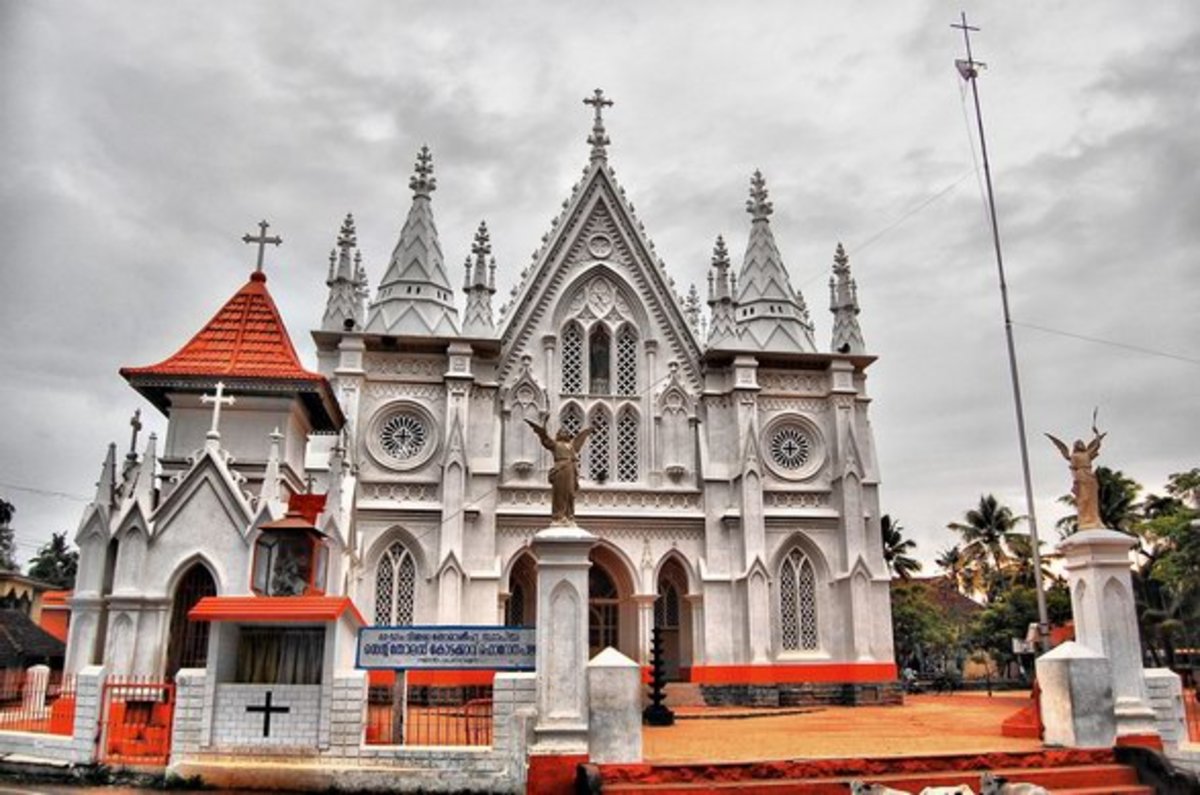
St Thomas Syro-Malabar Church, Kottakkavu

St Thomas Syro-Malabar Church, Kottakkavu

St Thomas Church, Kottakkavu, Kerala is one of seven ancient churches founded by St Thomas in 52 AD

Type
Church
Country
India
Location
Kottakkavu, North Paravur, Kochi
Scroll
01At a Glance

Kerala is a land so entwined with the history of the Christianity, it is no surprise that all the Apostolic churches in India are located here. In accordance with the will of his master Christ, to spread the good news to all the nations, St Thomas travelled to India on a merchant vessel and landed at the now lost port of Muziris. The St Thomas Church, Kottakkavu is one of the most important churches established by the Apostle. Located at an hour’s drive or 45 kms away from Cochin, this historical port sat at the mouth of the River Periyar where it meets the Arabian Sea. It was a voyage which in those days took fourteen days to accomplish, if aided by favourable winds. The Apostle is said to have established seven churches in Kerala after his arrival in 52 AD. The other six churches established by St Thomas were at Kodungalloor, Palayoor, Kokkamangalam, Chayal (Nilackel), Niranam and Kollam. In church terminology an Apostolic see (usually meaning the area of a bishop’s ecclesiastical jurisdiction), is one whose foundation is attributed to one or more of the apostles of Jesus or to one of their close associates. It is to the credit of India, especially for Kerala, that all seven of those ancient churches still exist to this day. St Thomas Church, Kottakkavu has today become a major centre of pilgrimage. In 829 AD, the Patriarch of the Church of the East, Timeotheus I sent the Persian Bishops Mar Sapore and Mar Proth to Kerala. The bishops were accompanied by Christian immigrants and traders, probably fleeing persecution in Persia. It was around the time of their stay in Kerala, that the second edifice of the Kottakkavu was built. An ancient cross said to have been erected by St Thomas himself, sadly no longer exists. It was destroyed by Tippu Sultan when his forces pillaged many churches across Kerala. Among the many historical objects that abound in the church the Kottakkavu Sliba is a prominent one. It is a Persian cross carved in stone, said to be from the time of Mar Sapore and Mar Proth, and is preserved in the St Thomas Church, Kottakkavu to this day. A relic of the Apostle is also preserved at Kottakkavu and is venerated every Wednesday. A pond is also attached to the church which was used by St Thomas to baptise new converts, mainly from the Jewish and Brahmin communities. The ancient practice of group baptism is kept alive at this church, and is re-created annually on July 3rd each year. The historically significant St Thomas Church, Kottakkavu is definitely worth a visit. It is located close to three basilicas, one of which is the National Shrine of Our Lady of Ransom at Vallarpadam .

1

The St Thomas Church, Kottakkavu is one of the most important churches established by the Apostle

2

The Apostle is said to have established seven churches in Kerala after his arrival in 52 AD

3

The other six churches established by St Thomas were at Kodungalloor, Palayoor, Kokkamangalam, Chayal (Nilackel), Niranam and Kollam

4

St Thomas Church, Kottakkavu has today become a major centre of pilgrimage

5

It was around the time of their stay in Kerala, that the second edifice of the Kottakkavu was built

02Plan Your Visit
Getting There
St Thomas Syro-Malabar Church, Kottakkavu, Palayur, Thrissur District, Kerala 680551

Palayur is approximately 18 km from Thrissur city. From Thrissur: bus or auto to Chavakkad (12 km), then to Palayur (6 km). By road from Thrissur: 30 minutes. By road from Kochi: 80 km, 2 hours.

Open in Google Maps →
IST (UTC+5:30)
--:--:--

The Palayur/Kottakkavu church is one of several Thomas Christian founding churches in Kerala that can be visited in sequence. Combine with Paravur, Kodungallur (Cranganore), and Niranam for a Thomas Christian heritage tour.

Opening Hours
Church6:00 AM - 7:00 PM daily
03Must See

What to seek out, and why it matters

I
At the church

The Apostolic Foundation Site

Standing in the Kottakkavu church at Palayur — on what tradition holds is the site of the first Christian community in India — is one of the most profound moments in the Thomas Christian pilgrimage. The continuity of this community across 2,000 years, through Arab rule, Hindu kingship, Portuguese colonialism, and British colonialism, into the modern Indian Republic, is a testimony to the depth of the planting.

II
Church context

The Brahmin Conversion Tradition

The tradition of the Brahmin conversion at Palayur — with the water miracle and the apostolic foundation — is one of the most specific and detailed stories in the Thomas Christian heritage. Whether historically verifiable in the modern sense or not, it establishes the self-understanding of the Palayur community: we are descended from those Brahmins who met the Apostle and believed.

III
During the liturgy

The Syro-Malabar Qurbana

The Syro-Malabar Qurbana at Kottakkavu — celebrated in the East Syrian tradition, in Aramaic/Syriac — is the liturgy that has been celebrated in some form at this site for nearly 2,000 years. The continuity of worship at one place across that span of time is itself an act of witness.

IV
Outside the church

The Surrounding Kerala Landscape

The Palayur area — Kerala coastal landscape, with coconut palms, paddy fields, and the sea not far away — is the landscape in which the first Indian Christians lived and prayed. The land itself has a particular quality when one knows that the community here has been Christian longer than most European Christian communities.

V
Surrounding area

The Thomas Christian Heritage Landscape

The Thrissur District area has multiple Thomas Christian foundation churches and historically significant communities. Visiting Palayur as part of a Thomas Christian heritage tour — including the Santhome Cathedral Basilica in Chennai and St Thomas Mount — connects the full arc of the Apostle's mission in India.

04Masses & Events
Qurbana6:00 AM and 9:00 AM on Sundays

Syro-Malabar liturgy

Feast of St ThomasJuly 3

The apostle's feast

Local Parish FeastVariable

Annual parish celebration

5Reflection & Prayer

The first church in India was founded in 52 AD. Rome was not yet a Christian city. The Apostle Paul had not yet reached Europe. Most of the New Testament had not yet been written. And Thomas was in Kerala, converting Brahmin families with water miracles and establishing a community that has never stopped worshipping. India was Christian before Europe. The first Indian Christians would have told the first European Christians what Christianity was. That is the truth that the Kottakkavu church embodies, in its ancient site, in its Aramaic liturgy, in its 2,000-year-old community.

John 1:14

The Word became flesh and made his dwelling among us. We have seen his glory, the glory of the one and only Son, who came from the Father, full of grace and truth.

Read in full on Bible Gateway →
A Pilgrim's Prayer

The Word became flesh in Palestine and made his dwelling among us. The Apostle Thomas carried the Word to India. The Word became flesh in Palayur in 52 AD, in a community of Brahmin families who saw a water miracle and believed. The Word dwells here still, in the Qurbana, in the Aramaic prayer, in the 2,000-year-old community. I stand in the place where the Word arrived in India. Let me receive the fullness of grace and truth that arrived here. Amen.

06More

Kerala is a land so entwined with the history of Christianity that it is no surprise all the Apostolic churches in India are located here. In accordance with the will of his master Christ, to spread the good news to all the nations, St Thomas travelled to India on a merchant vessel and landed at the now-lost port of Muziris. The St Thomas Church, Kottakkavu, is one of the most important churches established by the Apostle.

The Voyage of St Thomas

Located an hour’s drive, or 45 km, away from Cochin, this historical port sat at the mouth of the River Periyar where it meets the Arabian Sea. It was a voyage which in those days took fourteen days to accomplish, if aided by favourable winds. The Apostle is said to have established seven churches in Kerala after his arrival in 52 AD. The other six churches established by St Thomas were at Kodungalloor, Palayoor, Kokkamangalam, Chayal (Nilackel), Niranam and Kollam.

An Apostolic See

In church terminology, an Apostolic see (usually meaning the area of a bishop’s ecclesiastical jurisdiction) is one whose foundation is attributed to one or more of the Apostles of Jesus, or to one of their close associates. It is to the credit of India, and especially Kerala, that all seven of those ancient churches still exist to this day. St Thomas Church, Kottakkavu, has today become a major centre of pilgrimage.

The Persian Bishops

In 829 AD, the Patriarch of the Church of the East, Timeotheus I, sent the Persian Bishops Mar Sapore and Mar Proth to Kerala. The bishops were accompanied by Christian immigrants and traders, probably fleeing persecution in Persia. It was around the time of their stay in Kerala that the second edifice of the Kottakkavu church was built.

Historical Treasures

An ancient cross, said to have been erected by St Thomas himself, sadly no longer exists. It was destroyed by Tippu Sultan when his forces pillaged many churches across Kerala. Among the many historical objects that abound in the church, the Kottakkavu Sliba is a prominent one. It is a Persian cross carved in stone, said to be from the time of Mar Sapore and Mar Proth, and is preserved in the St Thomas Church, Kottakkavu, to this day.

A relic of the Apostle is also preserved at Kottakkavu and is venerated every Wednesday. A pond is also attached to the church, which was used by St Thomas to baptise new converts, mainly from the Jewish and Brahmin communities. The ancient practice of group baptism is kept alive at this church, and is re-created annually on July 3rd each year.

Visiting

The historically significant St Thomas Church, Kottakkavu, is definitely worth a visit. It is located close to three basilicas, one of which is the National Shrine of Our Lady of Ransom at Vallarpadam.

More from India
Church of St John the Evangelist (Afghan Church), Mumbai
Shahid Bhagat Singh Road, Navy Nagar, Colaba
All Saints Cathedral, Allahabad
Sarojini Naidu Marg, Civil Lines, Prayagraj (Allahabad)
Archdioceasan Heritage Museum, Mumbai
Archdiocesan Heritage Museum, St Pius X College, Aarey Road
Basilica of Bom Jesus, Goa
Basilica of Bom Jesus, Old Goa Road, Bainguinim